
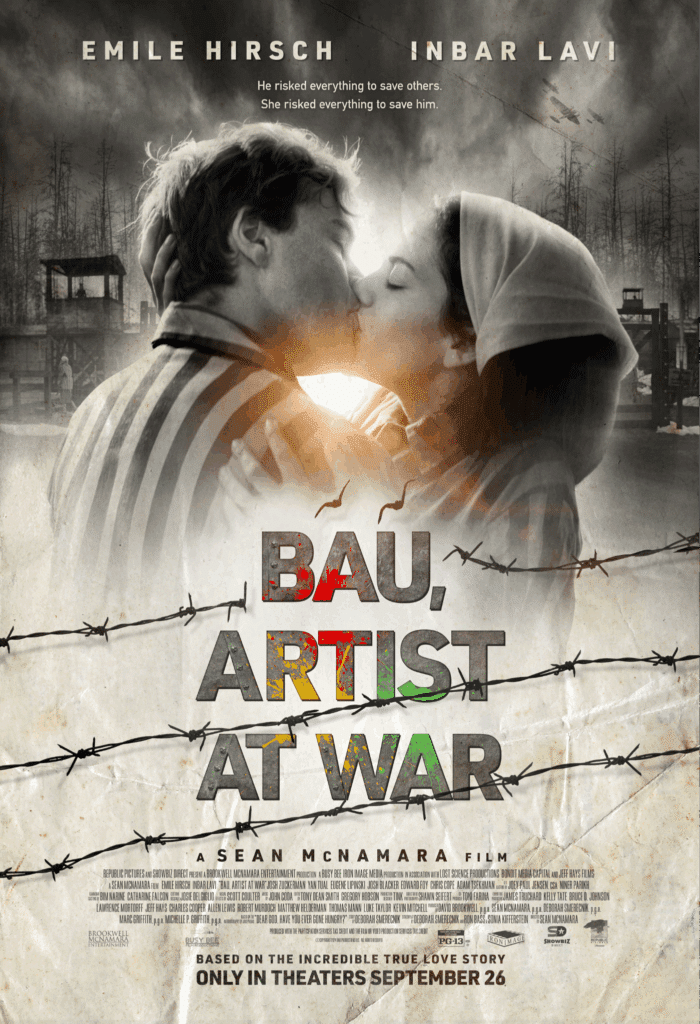
Reflecting on history affords us the chance to be reminded again and again that amid the greatest evils perpetrated by human beings there also surfaces the resilience of the human spirit. The horrors of World War II testify to this when new stories continue to find their way to the big screen. They offer something more than inspiration. They give humanity hope.
If you’ve seen Steven Spielberg’s Schindler’s List, then you may remember the scene when a young couple gets married in the Kraków-Plaszów concentration camp at the height of the war. Though brief, the scene is important because of the couple’s connection with businessman Oskar Schindler. Their story provides another testament to the power of love over evil. The couple’s names are Joseph and Rebecca Bau.

In Bau: Artist at War, director Sean McNamara (Reagan, Soul Surfer) masterfully portrays their account of survival through optimism and resistance. Written by Deborah Smerecnik, Ronald Bass, and Sonia Kifferstein based on Joseph’s illustrated memoir, Dear God, Have You Ever Gone Hungry?, the film artistically weaves in animated versions of Bau’s actual illustrations between somber black and white scenes of life in Nazi-occupied Poland.
We meet Joseph Bau (Emile Hirsch), an artist and animator who specializes in cartography, as an older man living in Tel Aviv, Israel in the 1970s. A young lawyer convinces him to testify in a war crimes trial against the vicious Nazi officer who zeroed in on Joseph while he was in a concentration camp. The story flashes back to that harrowing experience.

In 1943, Joseph creates forged identification papers for those brutally forced into the Kraków Jewish Ghetto. Armed with a jovial spirit, Joseph brings laughter to others in their tense situation by making flip book animations that mock the Nazis. His father (Eugene Lipinski) becomes angry saying Joseph will get them all killed. Joseph reveals the depth of his character when he responds, “I’m just trying to give people hope.” Speaking of the Nazis as simply men with guns, he says, “Your fear is their greatest weapon. It’s the first weapon we need to take from them.” He sets out on a mission to bring laughter and joy to all he meets.
Soon after, the SS liquidate the Ghetto and send the Jews to the Plaszów concentration camp for forced labor. There Joseph is selected by the cruel Kommendant Amon Goeth (Josh Blacker) to create maps of the camp and illustrated propaganda posters. But he also catches the eye of the sadistic camp officer Franz Gruen (Yan Tual) who becomes unnerved by Joseph’s sense of humor.
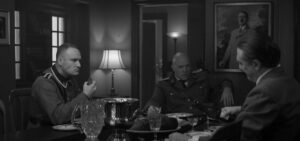
Filming in black and white, the director reveals life in the barracks as dreary and unbearable. Yet, Joseph finds hope when he discovers an underground resistance in the camp where he meets Polish Jews, Itzhak Stern (Adam Tsekhman) and Mietek Pemper (Chris Cope), who work in the Kommendant’s office. Both collaborate with factory owner Oskar Schindler (Edward Foy) who befriends Goeth to obtain workers for his operations. Through his talents, Joseph provides forged IDs for Schindler while keeping up with Goeth’s commands. Even after a beating by Gruen, Joseph’s hope, conveyed through his art, fuels the spirits of the other prisoners. His strength in the face of unimaginable difficulties reflects the biblical patriarch Joseph. He, who was sold into slavery because of the jealousy of his brothers, hopes in God’s promises even when all seems lost.
Since this is a film about an artist, I really appreciate the director’s choice to weave the visualization of Bau’s charcoal art into the story and as breaks in the film. Joseph’s caricatures of the Nazis reveal his witty artistic sense and offer insight into life in a camp. When we see Rebecca (Inbar Lavi) through Joseph’s eyes is the only time color appears in the film in the form of animated multicolored flowers as overlay on a grey palette. Captivated by her beauty, Joseph finds ways to meet Rebecca around the camp. They fall in love. And love turns the fear of darkness into vibrant, hope-filled light. What seemed like an impossibility becomes possible—a wedding in a concentration camp—unbeknown to the Nazis! It is the perfect defiance of Nazi cruelty lived through the beauty of unconditional love.
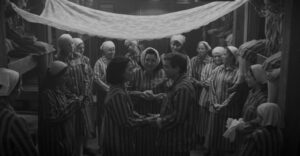
Rebecca, too, is involved in the resistance and uses her access to the Kommendant’s office to glance at lists of prisoners’ names to be sent to Schindler’s factory. Her work as a spy also saved the lives of many.
What McNamara has created is not just another war film, but a story that resonates in every human person who dares to hope when all seems lost. He buoys up the human spirit in the face of monstrous inhumanity through an inspiring love story, applicable for a world today that seems to forget history. Bau: Artist at War reminds us that hope is something that cannot be taken from a person. The one who hopes, loves. And the one who loves, lives.